
Piano
Lounge

After 50 years I am returning to the piano, so sit back, relax, grab a cup of tea, and listen to me butcher some of the greatest music of all time...
Method
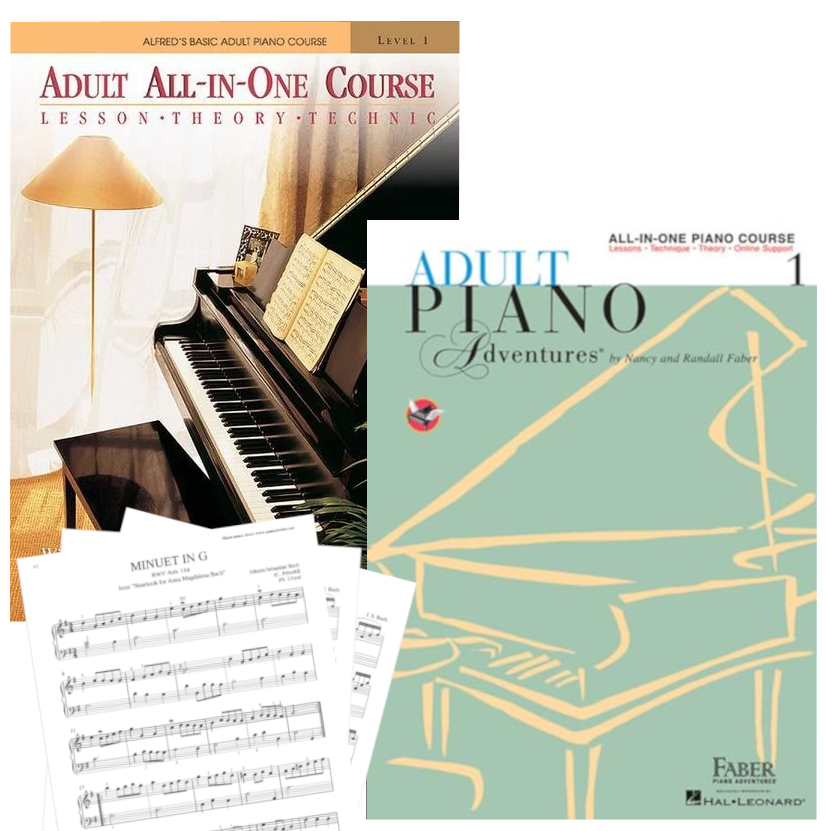
So how am I going to go about this? For reasons I won't bore you with - the best option - attending a qualified Piano Teacher is not really an option for me. What I am going to do is work my way through two of the more widely accepted self teaching books - Faber's Piano Adventures and Alfred's All-in-One Piano Course.
Both these books have good reputations, and if they can be separated, it seems to be, from public consensus, that the Faber is slightkly better for Classical type studies, while Alfred's is slightly better for more modern, contemporary playing. I would prefer to get a more Classical Training, but would also like to play some of the modern favourites like Elton John and Billy Joel. And these days, I've got planty of time on my hands, so why not got through both of them? One thing I do remember well from all those years ago - the more time you soend playiing, the more progress you see, so both books it is.
In addition to that - I am being guided by Jazer Lee's Essential Piano Roadmap for level approriate Classical Pieces. Jazer Lee is an Australian Online Teacher - he features quite heavily on YouTube. He has published a "Roadmap" which assists the student by guiding them towards excellent classical pieces aimed at an appropriate level for Beginner, Intermediate and Advanced students. So I will also be working my way through his suggested piece. Self teaching books like Faber and Alfreds are fine - but there is no substitue for getting stuck in to some good Classics.
And finally - just a few pieces I have always loved and want to play. Things like Mozart's Sonata in C K545. Most of thiese are probably a little too advanced for me at the moment - but there are "Easy" versions available and they are already on my "To Learn" list.
Wish me luck :)
Links
The internet has a remarkable talent for turning "I'll just check one thing..." into "...how is it suddenly 2:30 in the morning?"
Take the Wikipedia Spiral, for example.
It always begins with the most innocent of intentions.
"Who invented the piano?"
A quick click reveals the inventor. But then you notice a link to the harpsichord. Naturally, you click that. Which leads to the Baroque period, then to Johann Sebastian Bach, then to German principalities, then the Holy Roman Empire, then medieval castles, then siege warfare, then trebuchets (because who doesn't want to know how to launch a 290-kilogram rock 300 metres?), then gunpowder, then saltpetre, then bird droppings, and before you know it you're reading a surprisingly detailed article on the global history of guano.
At no point do you remember how you got there.....and your practice of "Morning" did not happen.
An hour has vanished. Your original question was answered fifty-nine minutes ago, yet you now possess an entirely useless but oddly satisfying knowledge of Peruvian fertiliser exports in the nineteenth century.
The truly frightening part is that if someone casually mentions guano at dinner next week, you'll confidently say, "Actually..." and proceed to explain it as though you've spent a lifetime studying bird excrement, despite having far more experience with the bovine variety.
That's the Wikipedia Spiral. Nobody intends to fall into it—but everyone does. One might think the Dunning-Kruger Effect was made to explain this phenomenon.
Don't do it!! At least don't let it replace Piano practice.
Here is a list of links I have found useful during my studies:
Contact

Do you have any comments? Suggestions (be nice!!), or tips for me - anything really.
Drop me a line - eMail me at:

About Me
So - I've retired.....now what?
Like many people, I took piano lessons as a child - between the ages of about 14 and 17. Can that really be 50 years ago? Where did those 50 years go? Looking forward, through bright 15 year old eyes, 50 years was an incomprehensible amount of time. Now, looking back through dimming 64 year old eyes - those 50 years passed in a flash.
I enjoyed my time playing, but as I grew life got in the way, and the piano fell by the wayside. But now I have time on my hands its time to revisit it. All those years ago I did sit the AMEB (Australian Music Examinations Board) exams, and got to 3rd Grade with reasonable results. Sure - I was no Lord Vinhitero - but I was doing OK - even my dear piano teacher Mrs Marinoli allowed me to play her best piano at times (but only after my hands were wahsed and fingernails cleaned and trimmed)
So of course now the question is - can I learn piano at 64? I don't see why not. I have the time - I have the piano - so as long as I stay motivated, and work at it, why wouldn't it come. but see for yourself - I am going to record all my progress here - from Lesson 1 onwards - seriously - don't expect too much!! :)